Showing posts with label Temple. Show all posts

Wednesday, March 9, 2016

TOURING THE TEMPLES

With so many temples to explore and ways to see them, it;s vital you make the most of your trip to Angkor. Annually, millions of tourist travel to Cambodia to see the incredible sites that Angkor Archaeological Park has to offer. At the centre of the Park sites the grandest and most popular of them all- Angkor Wat. The World Heritage Site was built for King Suryvarman II in the early 12th century as his state temple and capital city of the ruling Khmer Empire. While this is the most popular temple, there are plenty more to be explored.
The time-honoured way to temple trek is by Roe Mouk for about $20 a day, the driver will take you to all the main temples, offering an viewing of them and their legends as you drive, With up to four people this is a budget option but be advised that extra such as sunrise, sunset and some of the more distant temples cost more.
Tourist are not allowed to rent motorbikes in Siem Reap so hiring a motordop and drive is your next best bet. A motor allows you to tavel quickly and skirt the traffic that stacks up during evenings and holidays. Alternatively, starting at $5 a day, it is possible to cycle throughout Angkor at a leisurely pace, particularly if you have a three-day pass. There are scores of stranger ways to explore the temples. If you're with a group, why not try an electric car? Carrying up to 16 people, these carts provide a quiet, shady ride, and at just $3 per person are a great way to go. You can find tickets outside the south gate of Angkor Thom.

   ANGKOR WAT

  •  Date of construction: 12th century
  • Creator: King Suryvarman II
  • Function: State temple and king's mausoleum.
  • Style: Classical Khmer
  • Area: 162.6 ha
  • Famous for: Being the world's largest religious monument.
  • Best time to visit: Sunrise.
ANGKOR THOM

  • Date of construction: Late 12th century
  • Creator: King Jayavarman VII
  • Style: Khmer, Dravidian
  • Area: 9 km 2
  • Famous for: The faces on the 23 m towers at the city gates
  • Best time for visit: Early morning or late afternoon
TA PROHM

  • Date of construction: 1186.A.D
  • Creator: King Jayavarman VII
  • Function: Constructed to honour king's family
  • Style : Baroque Khmer architectural style (Bayon Style)
  • Famous for : The partial shooting of Tom Raider
  • Best time for visit: Early morning or late afternoon


Monday, February 29, 2016

Exploring Phnom Chisor Temple

Prasat Phnom Chisor that means Phnom Chisor temple is one of the important ancient temple in term of its history, architecture and its significance to religion. Built by King Suryvarman I, the 11th century temple is a dedication to Brahmanism made of laterite and bricks in which it produces a red image as the sun shines through it. Prasat Phnom Chisor is located 42Km, south of Phnom Penh Cambodia at Takeo Province.


The ruins are situated atop of a 130 meters hill at Roveang Village and going to the top is either by 198 steps stairs from the west or the 412 steps stairs on the south. Despite of the climb, the spectacular view of the countryside is worth-taking, and of course, the preserved carving found of the temple walls and doors. Prasat Phnom Chisor is one of the favorite getaways of Cambodians especially during the long holidays of Khmer New Year, Pchum Benh and Water Festival.

On the east of the temple area, going down the hill, are the ruins of gataways Sen Thmol and Sen Roveang. At the main temple area on top, several structures are situated such as the central tower and the surrounding 5 towers, the fire shrines and the galleries and walls surrounding the towers and shrines. The carving depicts different tales such as the one at the front entrance of the main tower showing the god Vishnu dancing, celebrating the fulfillment of the wishes of beautiful woman named Kari Kala Meya. She prayed to Vishnu to grant her wish of transforming her to an ugly woman so that the men from the human world, heaven and hell would not wage war against each other just to win and marry her.

Anther notable carving found on the east entrance door facing west of the center tower depicts Lady Uma sitting on Shiva's lap while riding on the flying cow. It shows the role of men as caring hsbands to their wives during that time. Aside from these, there are plenty of well-preserves carving, especially the sandstone lintels. awaiting to be explored by visitors. This is one of the reasons why visiting Prasat Phnom Chisor is worth-taking. Prasat Phnom Chisor is 5 Km, off from the National Road N.2. Turn right upon reaching the sign along the highway and head straight passing the twin towers of Prasat Neang Khmau or the eTemple of Black Lady. There is a fee of $3.00 when visiting the temple. It is also ideal to rent a car going there.


Monday, February 22, 2016

Ta Prohm Temple

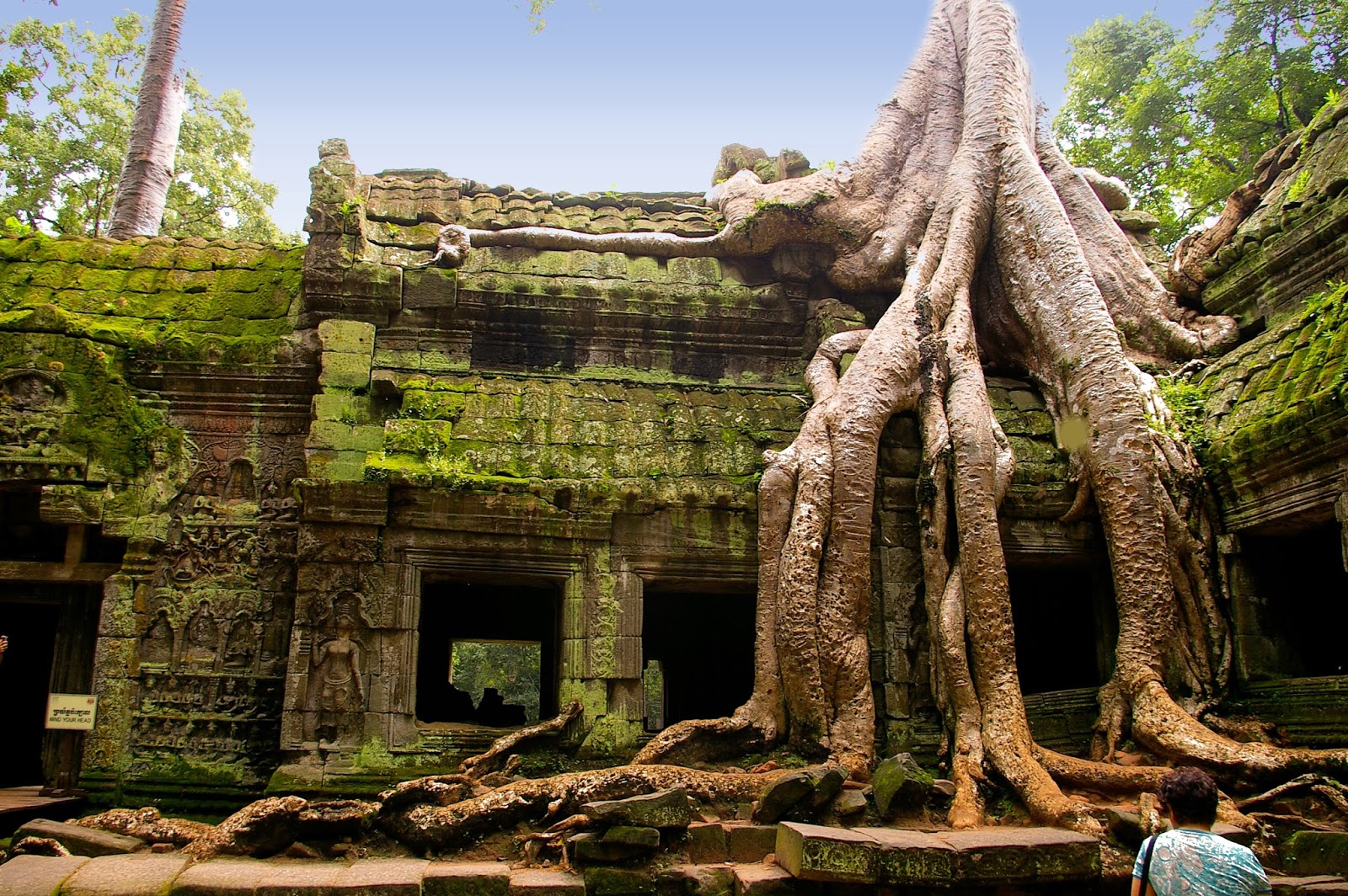
Ta Prohm is one of the most impressive temples in Cambodia's Angkor region, presenting the visitor with an intriguing and mystical  picture. Ta Prohm temple built by King Jayavarman VII during the year 1186 A.D. Surrounded by lush jungle, the complex is seized by towering trees that break through the base stone and devour the half-collapsed structures, their thick roots zigzagging through the floor and clambering up the walls.
In 1992, UNESCO awarded the temple World Heritage status. However, Ta Prohm's popularity really spiked in 2001, when the movie "Tom Raider; partially shot at Ta Prohm, showed famous actress Angelina Jolie walking between the temple's iconic tree roots. Ta Prohm is one of the few temples in the Angkor region that has been left much in the same condition that it was found. When the efforts to conserve and restore the temple of Angkor began the early 21st century, Ta Prohm was hand-picked to be left untouched due to its picturesque appearance. In its heyday, it was a vibrant city, home to more than 12,500 people, including high priests and dancers.

Angkor Wat Temple

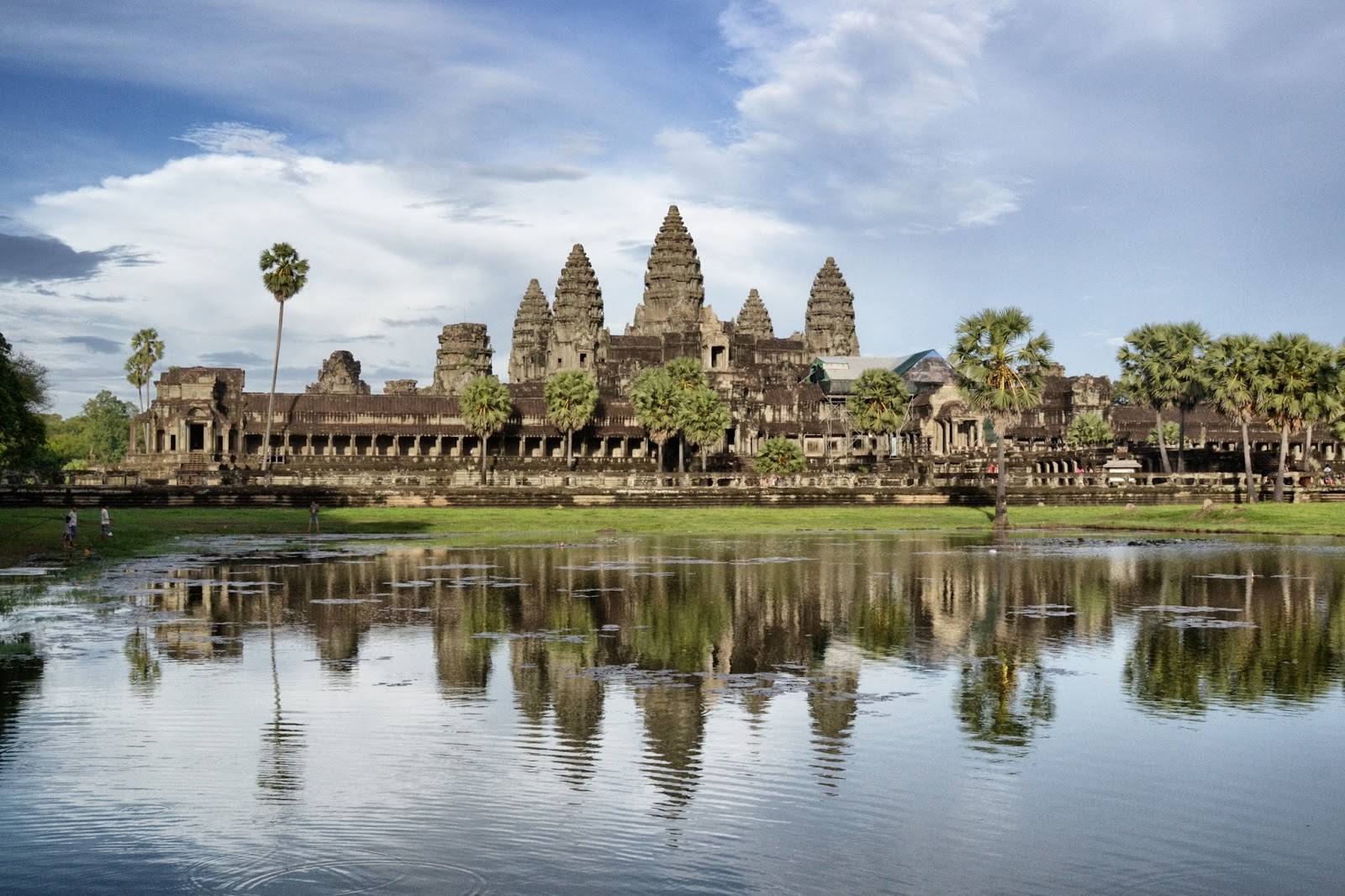
Angkor Wat temple built by King Suryavarman II, of the end 12th century. 
Angkor Wat is the jewel of the crown of the whole Angkor complex. As the largest religious monument in the world, Angkor Wat is a magnet for tourism into Cambodia, having received over two million foreign tourist in just 2013. The massive temple is now a symbol of Cambodia, even taking center stage on its national flag.
This behemoth- spanning 1,626,000 sq meters- was originally constructed as a Hindu temple for the Khmer Empire, to be later transformed into a Buddhist place of worship toward the end of 12th century. The temple is at the top of the high classical style of Khmer architecture. Angkor Wat combine two basic plans of Khmer Temple architecture: the temple-mountain and the later galleries temple. It is designed to represent Mount Meru, home of the devas in Hindu mythology. Unlike most Angkor Ruin temples, Angkor Wat is oriented to the west. The temple is admired for the grandeur and harmony of the architecture, its extensive bas-reliefs, and for the numerous devatas adorning its wall. 

Wednesday, February 17, 2016

Thommanon Temple one of the magnificence of Angkor

Thommanon Temple
Thommanon temple is a small, but a worth seeing one, situated 500 meters east of Angkor Thom's Victory Gate. A single-towered temple dedicated to Brahmanism, it was built in the late 11th and early 12th century by King Suryavarman II.

The temple complex is rectangular in shape with a sanctuary opening to the east, a moat, a rampart and two gopuras both located on the east and west. A library is also situated nearby on the southeast of the temple.
Thommanon temple is a part of Angkor Archaeological Park, which was inscribed as a UNESCO World Heritage Site in 1992.
Thommanon Temple

Thonmmanon seems to stand in conjunction with Chao Say Tevoda, located just across the road going to the gate, but was built decades earlier. The temple's carving are well preserved and the aged sandstone provides as distinct contrast to the surrounding jungle. Thommanon is in much better condition than the Chao Say Tevoda as it had undergone restoration by the French archaeologists in the 1960's. The structure and design of the temple has been concluded as  inspiration in building the Angkor Wat temple. It may not be one of the major landmarks in the park, but its fascinating beauty us surely worth-seeing.